
If the present rate of decline of the Canal & River Trust (C&RT) controlled inland waterways continues unchecked, there will soon be many fewer miles of navigable inland waterways left to write about on the internet, or anywhere else—or available for boating, writes contributor Tony Dunkley.
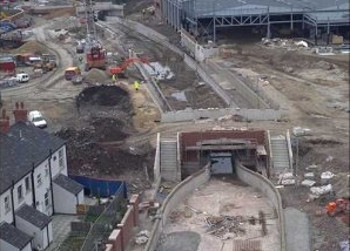 In the 1960's some changes for the better on our canals and river navigations accompanied the growing interest in holiday and pleasure boating, but those changes came to an end and were reversed in the mid to late 1990's, when responsibility for the operation and maintenance of the canals and river navigations under the control of the British Waterways Board passed into the hands of a new breed of modern so-called managers. People who were full of impressive sounding new ideas, but without any proven track record of ever successfully organising or running anything, and in reality, able and well versed mainly in what would amount to little more than crackpot guaranteed to fail schemes, meaningless flannel and well rehearsed excuses for their upcoming failures. [The picture shows the Huddersfield Narrow Canal being restored by the then British Waterways—one of many complete restorations.]
Such was the fate of British Waterways and of the inland waterways—OUR inland waterways—taken into 'public ownership' at the time of nationalisation in 1948, with around 2000 miles of them becoming the responsibility of the Docks & Inland Waterways Executive of the British Transport Commission, then the British Waterways Board in 1963. The UK's navigable rivers remained variously the responsibility of many other bodies and organisations—local River and Drainage Boards, the National Rivers Authority, and eventually the Environment Agency [EA]. These navigable rivers generally fared a little better than the British Waterways canals and river navigations, although of late they too have begun to suffer from and exhibit similar detrimental effects and problems to those widely evident on the British Waterways network.
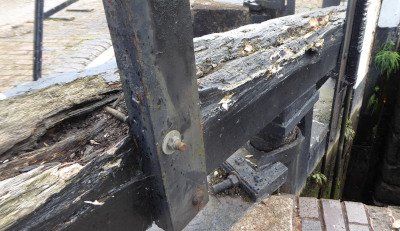 In 2012, things on the British Waterways canals and river navigations network took a very serious turn for the worse. As a direct consequence of getting on for nearly 20 years of the thoroughly bad management referred to in the last two paragraphs, British Waterways was in serious trouble—it was on its financial knees. The Government made the decision to distance itself from the financial black hole that British Waterways had created for itself and was staring into, and the whole mess was hived off to what is in effect a publicly (taxpayer) subsidised private company, limited by guarantee, masquerading as a charity, and calling itself a 'Trust'—which in turn led to the waterways being left to be maintained and operated by the C&RT, a poor substitute for a genuine Navigation Authority, the management of which consists mainly of covertly malevolent and overtly incompetents. [The picture shows the state of the infrastructure under Canal & River Trust.]
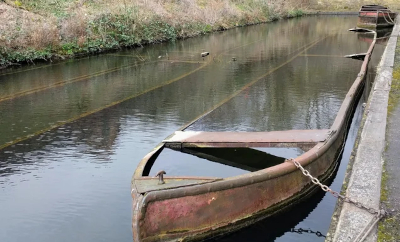 With all of British Waterway's tools, plant, and equipment long since flogged off by the C&RT at knockdown prices to the inexperienced, incompetent, and very expensive contractors who make such a lousy job of waterway maintenance and repairs these days, and the accumulated experience and know-how of generations of operating and maintenance staff—lock-keepers, lengthsmen, carpenters, bricklayers, plant operators, length foremen, section inspectors, area inspectors, and area engineers—positions and jobs now all consigned to history and replaced with well meaning but often clueless volunteers, and those bungling contractors who lack the necessary experience or skills for the work given to them—it may already be too late to rescue all of the total mileage of inland waterways presently in the unsafe hands of the C&RT. [The picture shows a sunken work boat, one of many that would not sell, so left to sink.]
Quite recently, a C&RT office employee describing herself as a 'Legal Co-ordinator', confessed that whilst employing barely sufficient total numbers of waterway maintenance staff to fill the average sized bus, this so-called Navigation Authority employs in the region of 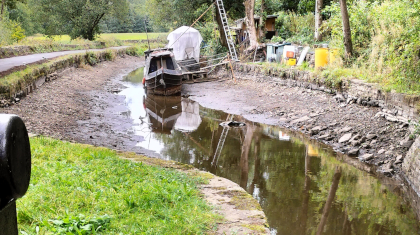 1,500 office and administrative staff, including ten (no, that's not a typo—it is x 10) fully qualified SRA rated Solicitors and Solicitor-Advocates, plus numerous other 'legal' staff. In total, that works out at one pointless office chair polisher collecting a wage or salary for approximately every 2,350 yards (one and a third miles) of overgrown, leaking, barely navigable waterway, decaying under C&RT's disastrous stewardship—while at the same time the C&RT management bleats about under-funding, and being too poor to maintain the waterways with which it has been so unwisely entrusted.
The C&RT controlled canals and river navigations, now generally approaching a state of near dereliction due to 13(+) years of inadequate or sometimes no maintenance at all, simply cannot and will not survive as a usable network of interconnected navigable waterways for very much longer in the hands of this distinctly unfit-for-purpose phony charity. [The picture shows the all-to-often drained Huddersfield Narrow Canal.]